20250920 PSK report (for FT-8) -2-
Pskreporter.info for Ham radio : )
Look!! JA JH5MXB on PSK report on 20m band(9/19)

A Oh My God!! still strong signal in the world.
B Today is very nice condition... but this level?... So great!!
C This is a joke... He had became " Voice Of America " ... : )
By the way .... My system case 2 ...
Rig ICOM IC-7200 25w only
Ant Long wire (abt L=20m )
JJ5IZX = All band + FT-8 (about 10 hour later check

.*. Check time was late about 10 hour . so different gray zone.
OK more than yesterday cover Area...but Almosu 15m + 30m band.
Why?? no good ..20m & 40m

JJ5IZX = 40m band + FT-8

JJ5IZX = 30m band + FT-8

JJ5IZX = 20m band + FT-8


JJ5IZX = 12m band + FT-8

JJ5IZX = 10m band + FT-8

※ 20mについてはあまりQRVしなかったのが本当のところ。
DP0GVN de JJ5IZX,
Please QRV on FT-8 ...
Ham radio stations around the world will be calling you.
Amateurfunkstationen auf der ganzen Welt werden Sie anrufen.
Very best 73`s : )
DP0GVN  Antarctica AntarcticaNeumayer Station III QSL: DL4BBH Email: Use mouse to view.. Ham Member Lookups: 568132 | | 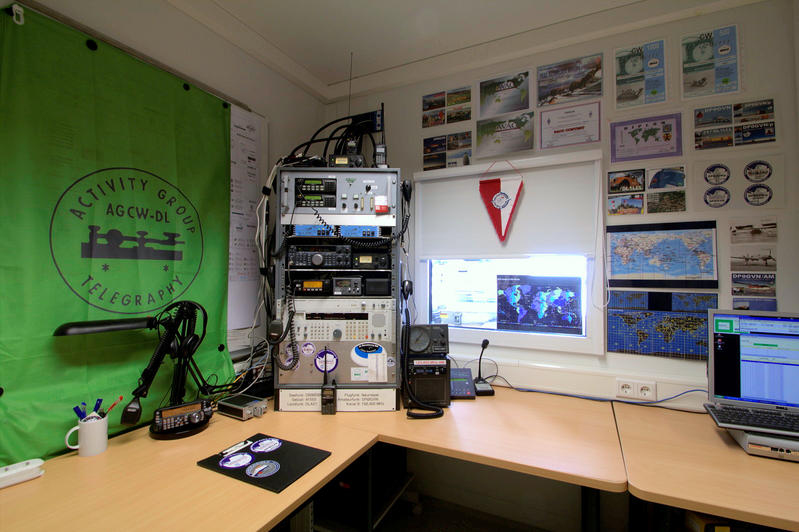 |
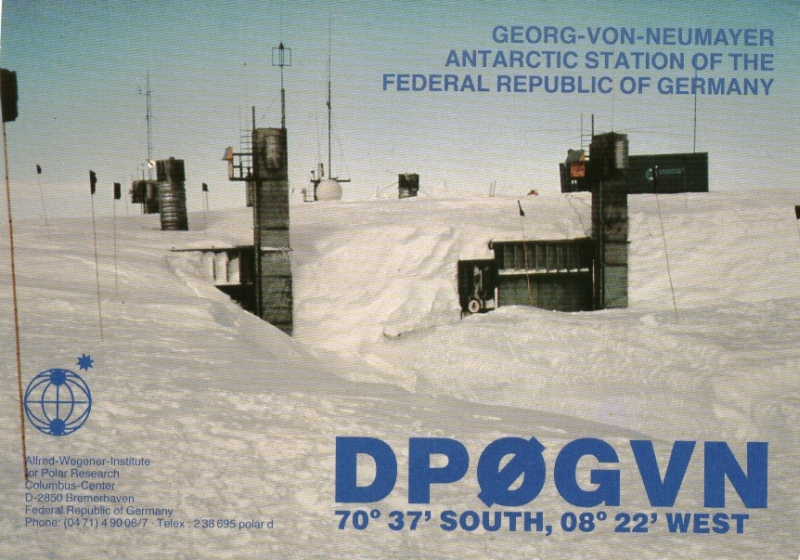
DPØGVN is a club station located at the German Antarctic Research Station "Neumayer III" in Dronning Maud Land, Antarctica. Find more on this outpost of global research at https://www.awi.de/en/expedition/stations/neumayer-station-iii.html. The call sign is regularly being activated by station personnel as well as visitors. QSL cards (both for HF and QO-100 satellite contacts) are available via DL4BBH, direct or via the DARC QSL bureau. Logs are also being uploaded to LotW irregularly.
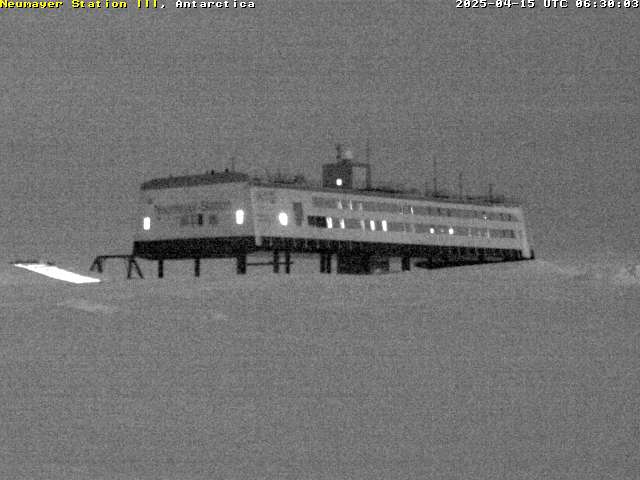
Current Webcam Picture:

WSPR Beacon
- Station Info
The setup consists of a receiver and a transmitter which independently of each other operate in the WSPR segments of the amateur radio HF bands.
- Receiver
The receiver is located at the "SpuSo" which is the station's air chemistry laboratory. SpuSo's main purpose is to collect continuous, year-round and long-term data records for important gaseous and particulate trace components of the troposphere. This observatory is located about 1.5 km south of the main station where it finds an outstandingly clean air environment.
This is a perfect place for a receiver setup because the RF environment, too, is amazingly QRM-free with a noise floor well 20, 30 or even more dB below of what we are used to in urban areas.
The receiver is a SDR built around three Red Pitaya (StemLAB 125-14 with 50 dB preamplifier). They permanently observe all eleven WSPR band segments between 160m and 6m and upload the spots to wsprnet.org. A BananaPi and a RaspberryPi single board computer take care of control tasks.
A third Red Pitaya is currently monitoring the ever-increasing FT8 traffic on the amateur radio bands. Properly decoded transmissions are reported to pskreporter.info.
Please note: This is an unmanned FT8 receiver working fully automated. There no way to do a two-way QSO with this installation. Calling DP0GVN on FT8 after being spotted or requests for FT8 QSOs with DP0GVN are therefore pointless, unfortunately. If you ever decode FT8 transmissions from DP0GVN, it means that the HF transceiver in the radio room is in operation, so in this case you might be able to work the station.
The antenna setup consists of two two triangle-shaped horizontal loop antennas with 1:4 baluns. The lower bands are received by an antenna with a circumference of 171 meters, the upper bands use a shorter loop of 61 meters.
The antennas are mounted on short masts about one to two meters above the ice shelf. This is not "above ground" as the ice shelf is almost invisible to HF. You even can use antennas lying flat on the ice to do HF QSOs! The real ground is about 200 meters below as this is the average thickness of the ice shelf in this area. Every year precipitation adds about one meter of snow and ice. Therefore the antennas have to be reestablished regularly to not risk having them covered by snow.
- Transmitter
The transmitter is located at the main station and is based on the TX design of the Charly-25 SDR project. Ats it heart is another Red Pitaya StemLAB 125-14 which feeds a rock-solid PA designed to emit up to 20 watts RF. The Red Pitaya runs Pavel Demin’s WSPR transceiver software. A PC Engines APU2 single board computer is in charge of control and monitoring tasks. RF output, SWR and system temperature are constantly monitored.
The antenna is an approx. 20 meter long wire installed on the southern part of the station’s roof. The wire runs in North-South direction and is matched by a 1:9 Unun-type RF transformer. While not being a high-performance antenna it is well suited for the task because it is broad band and believed to be able to stand the stress caused by the extreme Antarctic whether conditions.
The transmitter transmits on all WSPR segments between 160m and 6m on a round-robin schedule. One complete cycle takes 30 minutes. The bands between 40 and 17 meters are served twice per cycle because these offer the best chances for the signal to be heard. So these four bands are visited four times per hour, the other bands twice per hour. The RF output is 5 watts on all bands.
Update June 2020: On 2020-06-04 something in the RF transformer feeding the long wite antenna broke causing the antenna to be unusable. Therefore we are currently transmitting with the 5.5m vertical antenna which was already in use for the project before 2020. This antenna offers a less favorable radiation pattern when compared to the long wire, so expect somewhat degraded reception opportunities. Maintenance work at the antenna can only take place during Anarctic summer so that the repair will not be executed before January 2021.
- The Project
This setup is a long-term project realized by the Technical University of Munich (TUM) and the Hochschule Bremen City University of Applied Sciences (HSB) in cooperation with the Alfred Wegener Institute Helmholtz-Zentrum für Polar- und Meeresforschung (AWI) and the German Amateur Radio Club (DARC). AWI operates the Neumayer Station III and provides logistics. DARC builds and maintains the receiver and transmitter setup.
The project is meant to run several years to gain long-term data on radio propagation and spectrum pollution in a very specific HF environment as the station is located within the southern auroral oval. The setup will see changes in the future -- we will keep you updated here. As the station is inaccessible from the outside world for about eight months during south polar winter modifications will usually happen during the Antarctic summer season between November and February.
- Short outline of the project’s history
May 2017: The project is formally accepted upon the result of a scientific review; it also receives passes the mandatory assessment for impact on the Antarctic environment by the German Federal Environment Office.
January 2018: First deployment of receiver and transmitter. The receiver monitors eight bands in parallel (switching the set of bands between daytime and nighttime). The transmitter is a QRP Labs U3S transmitting on four bands between 40 and 17 meters into a five meter long plain vertical radiator on the station’s roof matched by a passive broadband matching network. Transmission power is between 1 watt on 17 meters and 5 watts on 40 meters.
January 2019: Installation of a commercial T2FD antenna on the station roof to extend the range of transmission bands. The antenna got damaged in mid 2019 due to severe weather.
January 2020: Deployment of the second generation of receiver and transmitter. The receiver is now capable of monitoring 16 bands in parallel. The transmitter can operate on all HF bands plus 6 meters. The transmission antenna is now a 20 meter long wire matched by a 1:9 Unun RF transformer.
June 2020: A damage in the feed of the long wire transmission antenna forces a switch to the less performant vertical antenna. At about the same time the 171m loop antenna at the RX ruptured but could be repaired two weeks later.
Related Links
- More on station in Wikipedia
- Current Weather in APRS
- Recent meteorological measurements
Current and previous activations
- QO-100 satellite ground station by AMSAT-DL:
permanently installed, different operators (DC1TH, DK7DA, DM2KX, DL1TOG, DL5XL, HB9HCF)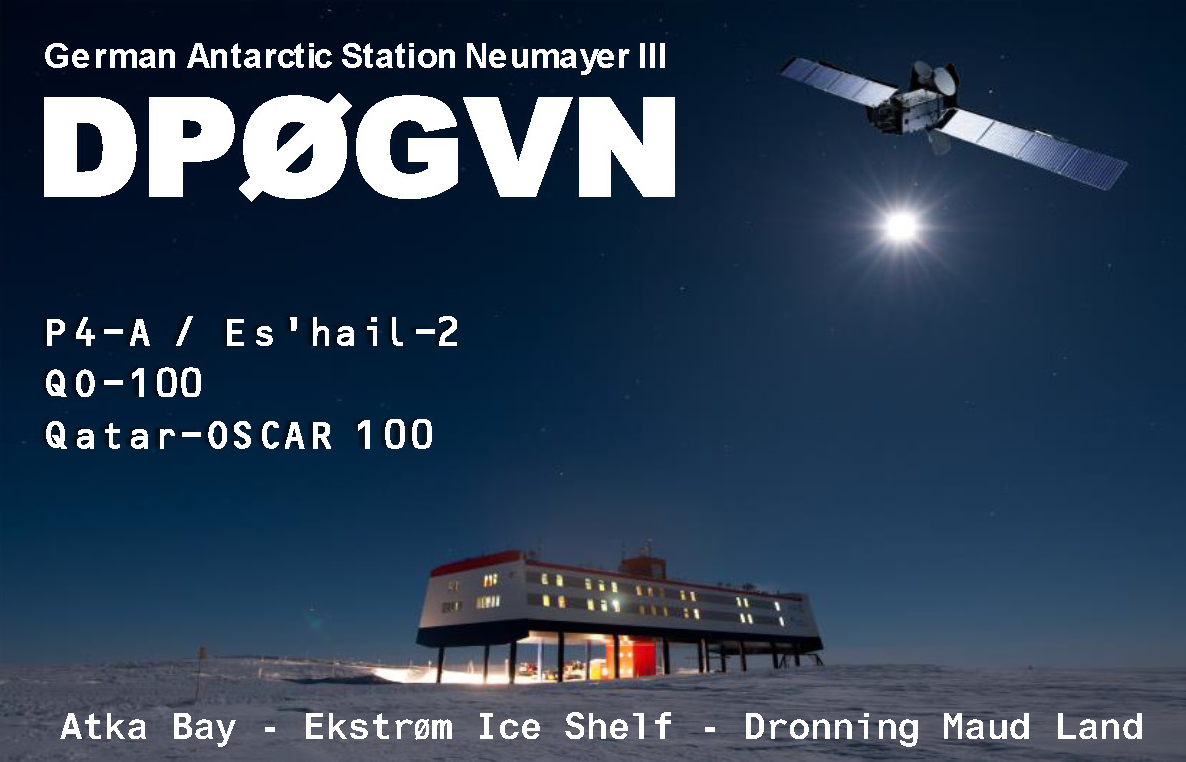
- November 2024 to January 2026: OP Alex, DL2ALY (45th wintering team)
- December 2023 to January 2025: OP Jörg, DO5JL (44th wintering team)
- December 2022 to February 2024: OP Markus, DK7DA (43rd wintering team)
- January 2022 to February 2023: OP Karsten, DM2KX (42nd wintering team)

- January 2021 to February 2022: OP YL Theresa, DC1TH (41st wintering team)
- December 2019 to February 2021: OP Roman, HB9HCF (40th wintering team)
- December 2018 to February 2020: OP Andreas, DL3LRM (39th wintering team)
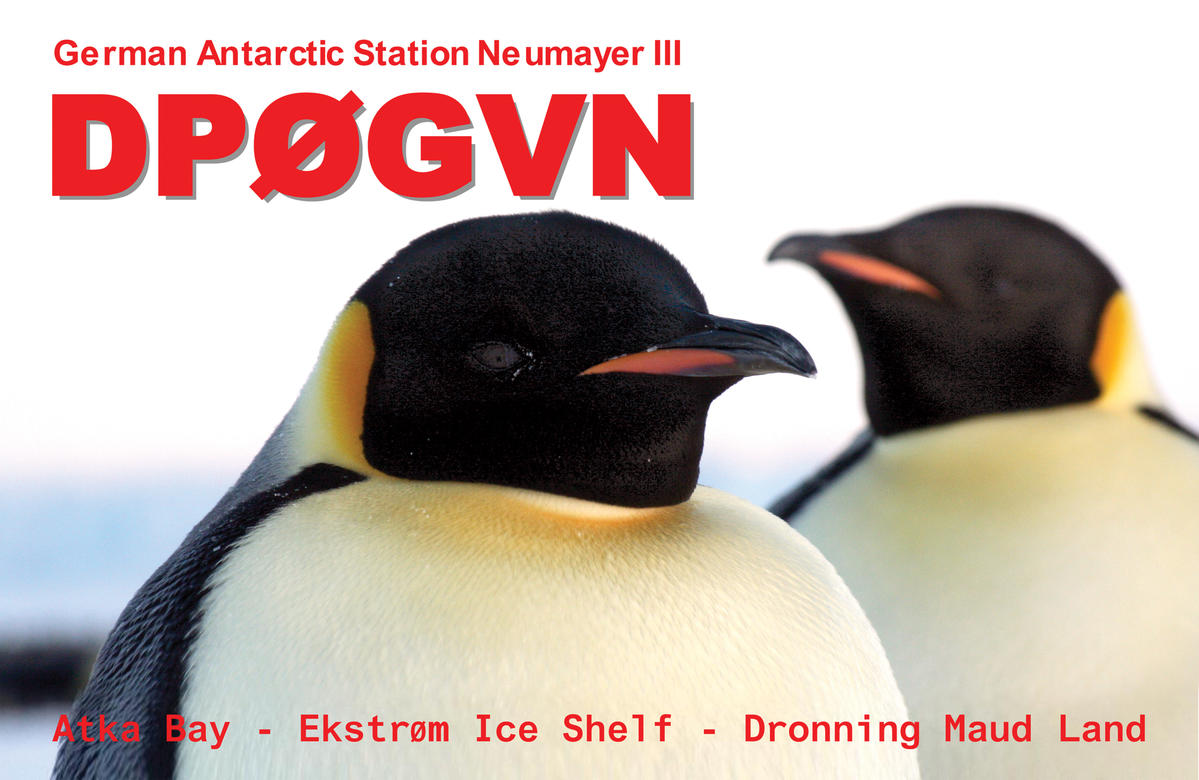
- December 2017 to February 2019: OP Matthias, DH5CW (38th wintering team)
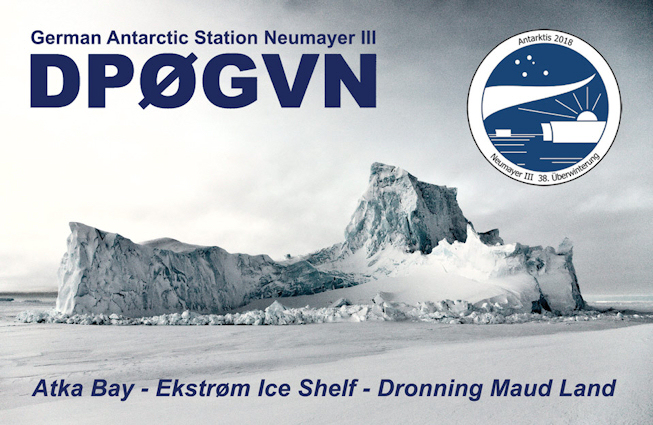
- December 2016 to February 2018: OP Daniel, DL1SU (37th wintering team)

- December 2015 to February 2017: OP Marcus, DL1MH (36th wintering team)
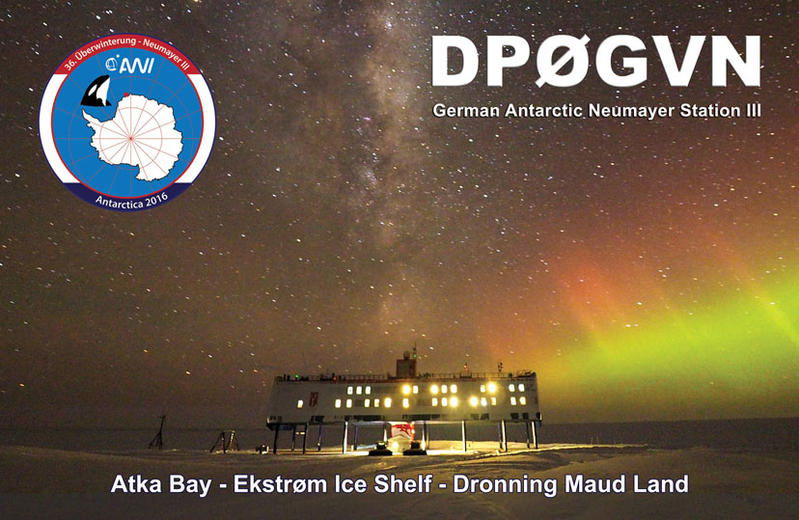
- December 2013 to February 2015: OP Holger, DH1HB (34th wintering team)
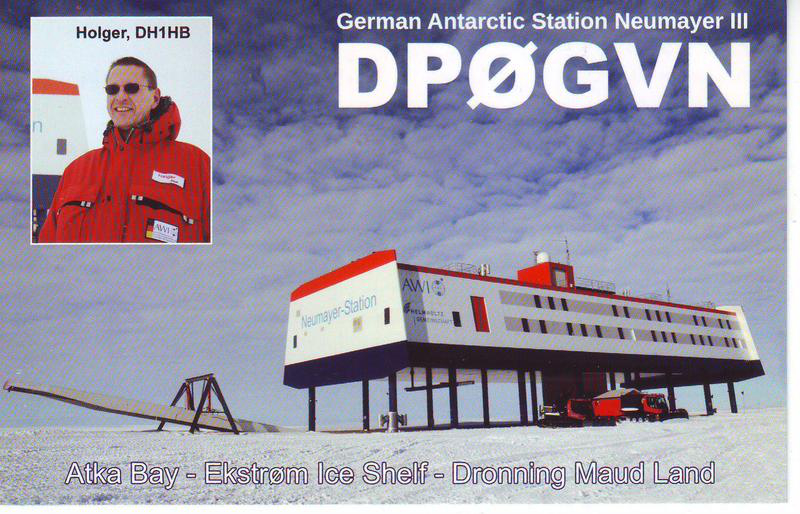
- December 2011 to February 2013: OP Lars, DL1LLL (32nd wintering team)

- March 2010 to February 2011: OP Guido, DL9EG (30th wintering team)
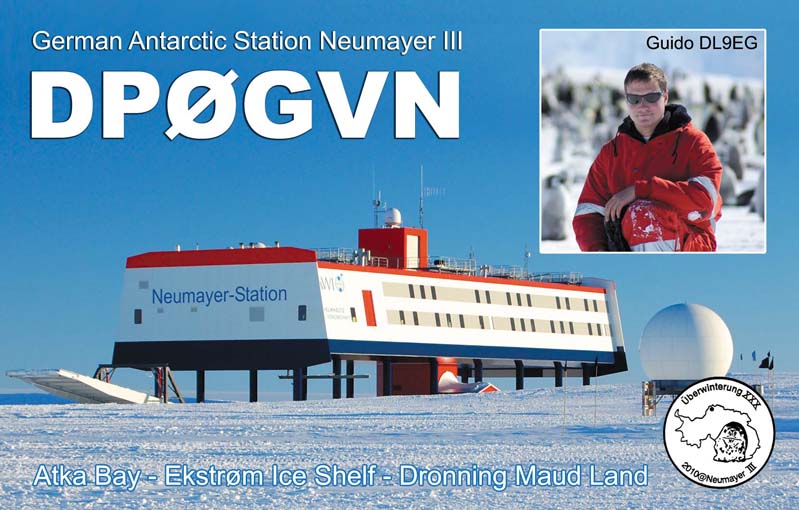
- December 2007 to March 2008: OP Felix, DL5XL
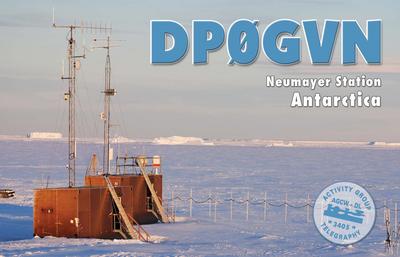
- December 2006 to February 2008: OP Mirko, DG1MD (27th wintering team)

- December 2005 to February 2006: OP Torsten, DL1TOG
- December 1995 to February 1997: OP Gustav, DL3OAY (16th wintering team)
- November 1992 to March 1994: OP Volker, DL8JDX (13th wintering team)
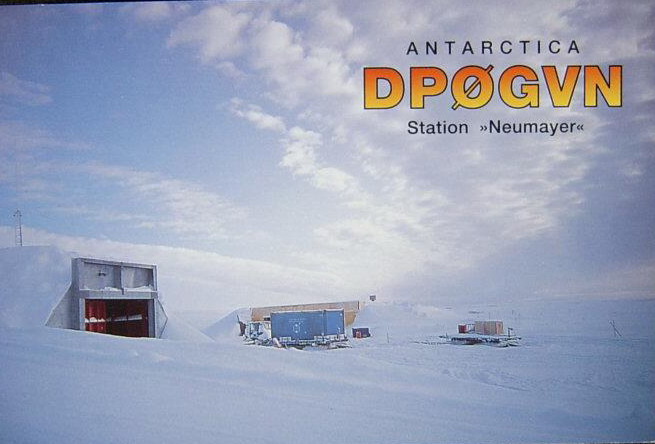
- December 1987 to February 1989: OP Gustav, DL3OAY (8th wintering team)
- December 1985 to February 1987: OP Axel, DF9LX, and OP Gustav, DL3OAY (6th wintering team)
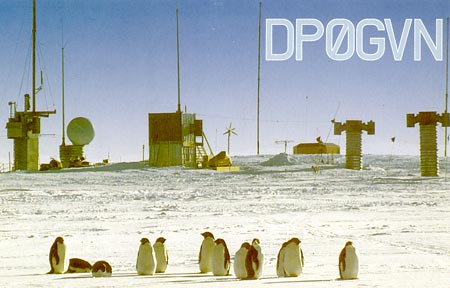
- December 1984 to February 1986: OP Gunter, DJ6TN, and OP Lothar, DG5SL (5th wintering team)

No comments:
Post a Comment